
How to Work From Home With Kids
in 2026: Focus, Family Balance, and the Honest Truth

- Research from Northwestern University found that parents who work from home with kids report higher stress levels than on-site workers — acknowledging this honestly is the starting point for building a system that actually manages it.
- Parenting is its own full-time job — you can occasionally power through unexpected childcare time, but you cannot assume you will always be available to do so. Sustainable remote parenting requires coverage, not just scheduling.
- Front-load deep work during your quietest hours — often before the house wakes up. Build consistent visual boundaries and micro-routines that protect focus without guilt.
- Hold a family meeting to discuss your work schedule, specific quiet times, and responsibilities. Empower kids by involving them in problem-solving: "What ideas do you have for keeping busy while I'm in my meeting?"
- What works today might not work tomorrow — expect to remake the schedule and experiment with new ideas, and you will be less stressed than if you try to rigidly stick to a "perfect" system.
- Working from home with kids is not a productivity problem. It is a resource allocation problem — the right childcare coverage, scheduling strategy, and family communication make professional remote work and active parenting genuinely compatible.
The Least Honestly Addressed Challenge of Remote Work
Somewhere between the first video call with a toddler wandering into frame in 2020 and today, working from home with children became one of the defining challenges of the remote work era. It is also one of the least honestly addressed — most productivity advice treats it as a scheduling problem, when the people actually living it know it is something more complex than that.
But research from Stanford, published in Nature, found that employees on a hybrid schedule were just as productive as those in the office full-time — and many working parents manage professional remote work and family life in the same household effectively. The difference between those who manage it and those who find it unsustainable is almost always structural: the right coverage, the right scheduling, and the right family communication — not more willpower.
This guide covers all three. If you want the broader framework behind the scheduling advice below, our guide to how to manage your time working from home in 2026 is a good companion read.
The Honest Reality: What Is and Is Not Possible
Before any strategy, one honest foundation: you cannot do full-time professional work and primary childcare simultaneously without one or both suffering. This is not a failure of planning or effort — it is arithmetic. Two full-time demands cannot both be met fully at the same time by one person.
While you will probably be able to occasionally power through unexpected childcare time — a snow day, a caregiver who calls out — you cannot build a sustainable system on that assumption.
Starting with this honest foundation produces realistic plans that actually work — rather than optimistic schedules that collapse by Tuesday.
The Foundation: Childcare, Coverage, and Realistic Expectations
Understanding what level of care your kids need — and whether help is something you will need — is the first consideration for any remote working parent.
- School hours: Your primary professional window if children are school-aged. Protect this time aggressively — deep work here, not errands and admin.
- Childcare (part-time or full-time): Even a few hours daily creates a reliable focus window.
- Partner split schedule: Alternating primary childcare across the day creates coverage without external costs — see the split schedule section below.
- Nap times and early mornings: The most reliable deep focus periods for parents without other coverage — protect them for your highest-priority work.
Scheduling Around Your Kids' Natural Rhythm
Plan your day around your kids' routines — use naptime or quiet hours for focused work. The key principle is building the work schedule around the family's natural rhythm rather than imposing a rigid work schedule over the top of it.
| Child's Schedule | Available Work Window |
|---|---|
| Pre-wake early morning (6–8am) | 2-hour deep work block before the household begins |
| Infant nap (9–11am) | 2-hour deep work block |
| School hours (9am–3pm) | Primary professional window |
| Toddler independent play (3–4pm) | 45-minute shallow work |
| After bedtime (8–10pm) | 1–2 hours — use sparingly, rest matters |
Age-Specific Strategies: What Works at Each Stage
Children's capacity for independent activity — and therefore their parents' available focus time — changes dramatically with age. What works for a six-year-old will not work for a two-year-old; what works for a ten-year-old is different again.
Reality check: Infants require continuous proximity and responsive care. Deep focus work during infant care is not reliably possible without dedicated childcare coverage.
- Nap time is sacred — highest-priority work goes here, not chores or admin
- Baby-wearing for brief shallow work periods (email, low-stakes admin)
- Early morning window before the baby's first wake can provide 60–90 minutes of genuine focus
- Flexible employer arrangements to distribute hours across evenings once a partner is home
Reality check: Toddlers require supervision but can manage short periods of independent activity — typically 15–30 minutes before needing attention.
- Activity stations — a defined tray of toys, play dough, or craft materials — rotated weekly to maintain novelty
- Screen time as a deliberate tool reserved for important calls, not used continuously
- Nap times for focus-intensive tasks; awake periods for work that tolerates interruption
- A consistent pre-nap routine that signals quiet time is coming
- Independent play extends to 30–45 minutes with structure — a quiet time corner or a "busy bag"
- Clear, consistent visual signals for "work time" — closed door, headphones, a visual timer
- Concrete time markers: "I work while the sand timer runs out, then we have snack together"
- 20–30 minutes of active outdoor play before a focus period significantly extends independent activity time after
- School hours become the primary professional window — protect them fully
- After-school homework time provides a natural 45–60 minute window of independent activity
- A family meeting on the work schedule — kids this age can genuinely help maintain it when involved in creating it
- A shared family calendar showing parent work time builds predictability and reduces interruptions
- Genuine independence makes household scheduling simpler — the primary need is communication, not supervision
- Clear expectations about noise levels and workspace respect are usually sufficient
- Teenagers can be valuable partners in younger sibling management — with appropriate acknowledgment rather than assumption
The Visual Boundary System — Teaching Kids to Respect Work Time
Kids respect boundaries when they are consistent and visual. The most effective boundary systems rely on physical and visual cues rather than verbal repetition — because children respond to predictable, consistent signals far better than to repeated explanations.
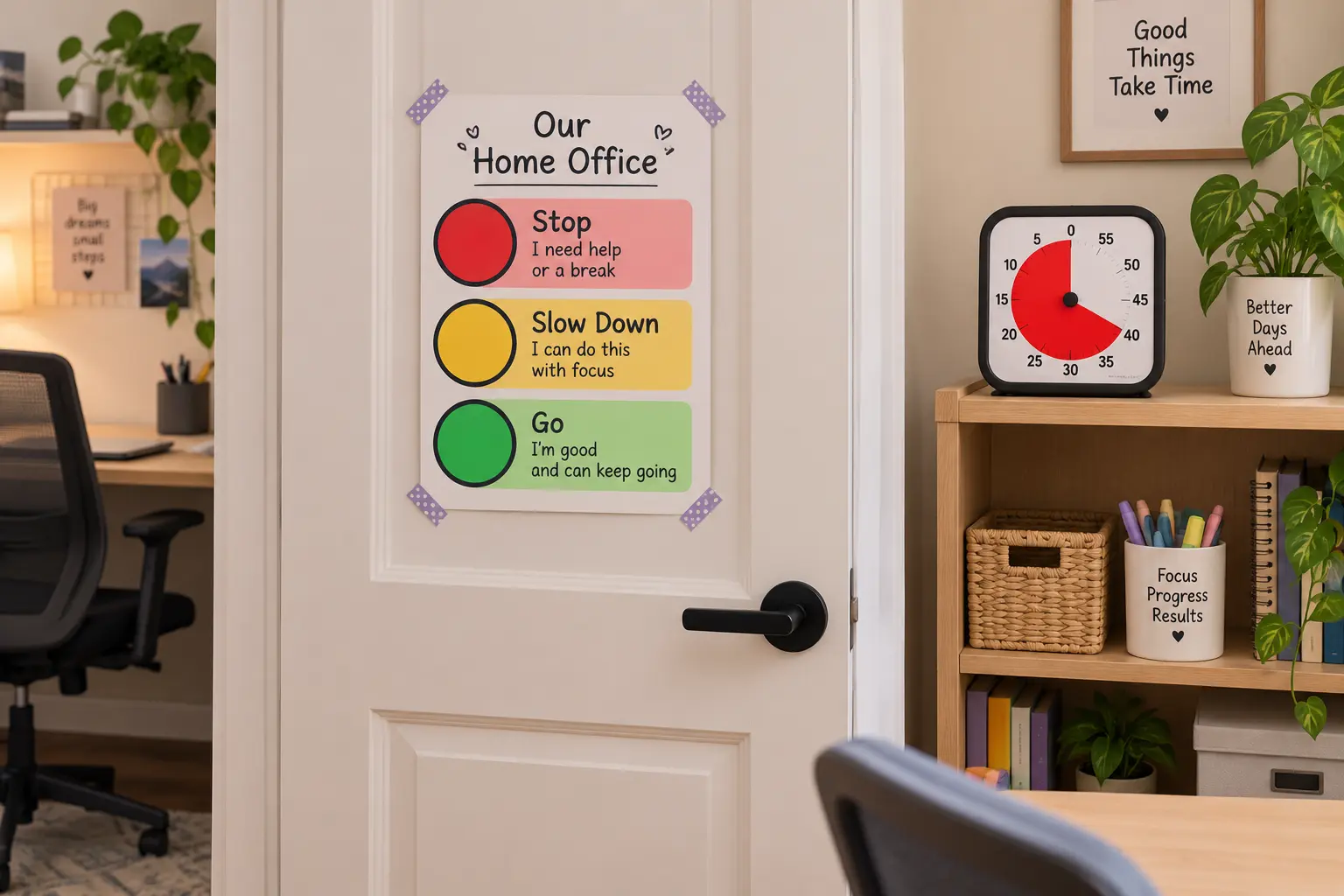
The Traffic Light System (best for ages 3–8)
Introduce the system with a brief family meeting. Practice it before it's needed. Reinforce consistently for two to three weeks. Most children aged 4+ understand and follow it reliably once it's predictable.
Deep Work With Children at Home: The Only Reliable Methods
Honest summary: reliable deep work when young children are present without another adult for coverage is extremely difficult. The methods below are the most effective available, not the perfect solution.
- Method 2 — Nap time / school hours: the scheduled windows — protect them for your most cognitively demanding work, not chores or email
- Method 3 — Tag-team with a partner: when each partner takes two-hour primary childcare blocks, the other gets genuinely uninterrupted time — see the split schedule below
- Method 4 — Childcare overlap scheduling: if any coverage exists, schedule your most critical obligations inside it without exception
Meeting Survival Strategies for Parents
Video calls are the highest-stakes focus requirement for working parents — because they involve other people, and interruptions are publicly visible.
- Communicate proactively with your team. "I have a young child at home and occasionally they appear on screen" is more professional than pretending otherwise.
- Schedule all critical calls within your covered window — school hours, nap times, or a partner's coverage block.
- Use a pre-meeting engagement plan — a novel activity saved specifically for high-stakes calls extends independent engagement significantly.
- Use screen time strategically — reserved for important meetings rather than used throughout the day, so its scarcity preserves its reliability.
- Have a backup plan and name it out loud — a brief, calm acknowledgment and a 30-second pause if your child enters is far better than pretending nothing happened while visibly stressed.
Managing the Guilt
Guilt is a common companion for work-from-home parents, but it is often unproductive. Recognize that you are doing your best in a demanding situation. Focus on presence over perfection — when you are with your kids, be with them fully, even if it's for short bursts.
The guilt itself does not make you a better parent or a better professional. It just makes both harder. Give yourself the same grace you would extend to a colleague in the same situation.
The Partner Split Schedule (For Two-WFH Households)
When both partners work from home, the most effective childcare strategy for young children without external coverage is the tag-team model: alternating primary childcare responsibility across defined blocks throughout the day.
| Time | Partner A | Partner B |
|---|---|---|
| 6:00–8:00am | Deep work | Primary childcare |
| 8:00–10:00am | Primary childcare | Deep work |
| 10:00am–12:00pm | Meetings / shallow work | Meetings / shallow work |
| 12:00–1:00pm | Lunch together as family | |
| 1:00–3:00pm | Primary childcare | Deep work |
| 3:00–5:00pm | Deep work | Primary childcare / meetings |
| 5:00pm+ | Family time | |
Weekly calendar coordination: Review the coming week together every Sunday evening. Identify high-stakes calls, deadlines, or childcare uncertainties, and adjust the split to give extra coverage to whichever partner has the highest-stakes commitments that week.
The Weekly Family Work Calendar — 15 Minutes Every Sunday
The most consistent difference between working parents who manage remote work and family successfully and those who find it unsustainable is not time management skill or childcare quality — it is visibility. Everyone in the household knowing what the week looks like.
Name the week's biggest childcare risk in advance and solve it before it becomes a crisis. This protocol is adapted from our weekly planning guide, specifically for households with children.
Common Mistakes Working Parents Make
Frequently Asked Questions
A Workable System, Not a Flawless Performance
Working from home with children is genuinely one of the more challenging aspects of remote work — research confirms remote working parents report higher stress than office-based parents, and that is an honest reality worth acknowledging rather than minimizing.
What the same research also shows is that remote and hybrid work provides genuine advantages for families — schedule flexibility, proximity to children, eliminated commuting time, and presence for moments office work would miss entirely.
Start with the family work calendar this Sunday. Build the visual boundary system this week. Have the family meeting. Adjust next week based on what you learn.
Add a Comment